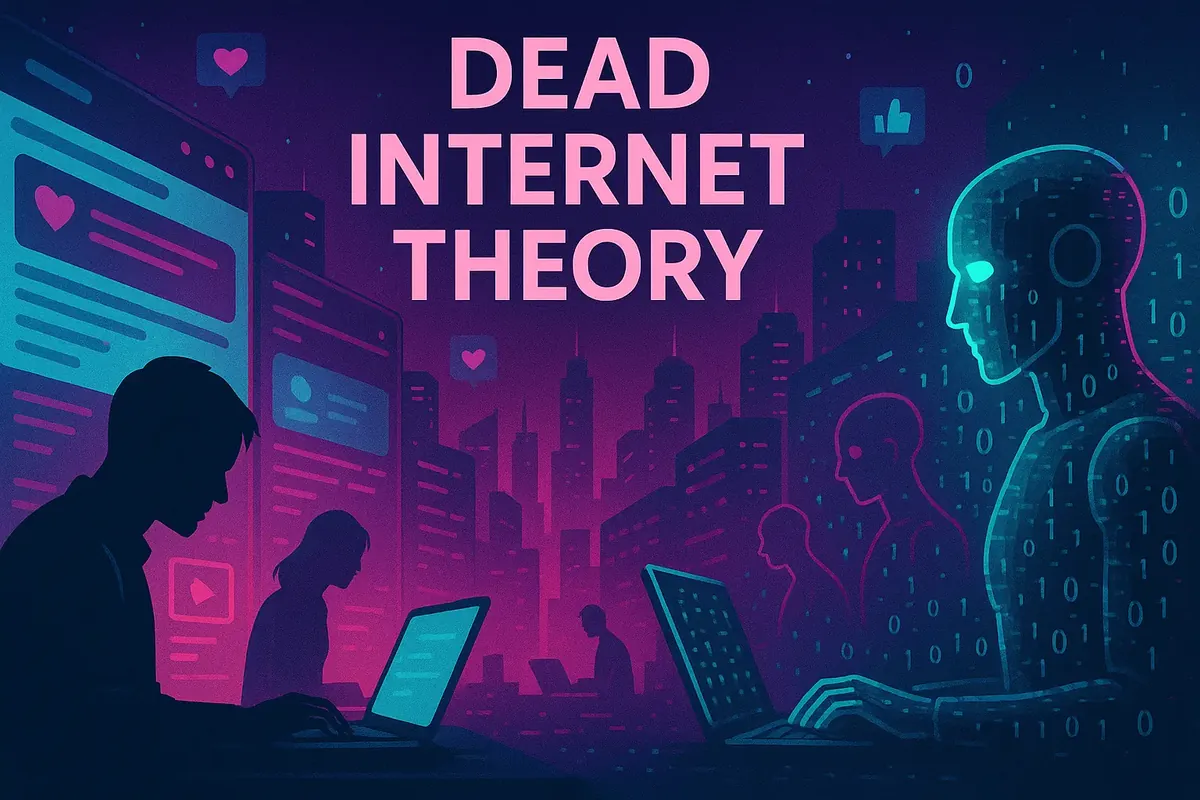
The "Dead Internet Theory" has been circulating since around 2021. It claims that most online content is now generated by bots and AI, that organic human interaction has declined sharply, and that major platforms are artificially propping up the illusion of a vibrant web.
The full conspiracy version is far-fetched. But the kernel of truth is worth paying attention to if you're trying to market a real business online.
What's Actually True
Bot traffic is significant. Imperva's 2024 Bad Bot Report found that 49.6% of all internet traffic comes from bots. That's not to say the internet is "dead" — but roughly half of your website's visitors are not human.
AI-generated content is increasing rapidly. In April 2025 Ahrefs analysed 900,000 newly published web pages and found 74.2% contained some AI-generated text. Only 25.8% read as entirely human-written, and 2.5% as entirely machine-written — the bulk of the web is now a mix of the two rather than one or the other.
Social engagement patterns have shifted. Organic reach on major platforms has declined. The engagement you see (likes, shares, comments) increasingly includes algorithmic amplification, bot accounts, and engagement pods.
What This Means for Marketers
If a significant portion of the internet is synthetic — AI content, bot traffic, algorithmic amplification — then the signals we use to measure marketing effectiveness are noisier than ever.
Implication 1: Organic reach metrics are less reliable. 10,000 social media impressions doesn't tell you how many humans saw it.
Implication 2: Genuine human engagement is more valuable. Real comments, real conversations, real referrals from real clients carry more weight both algorithmically (platforms are trying to detect authenticity) and commercially.
Implication 3: First-party data matters more. You own your email list. You don't own your social following. Email engagement data is cleaner and more reliable than social metrics.
What to Do About It
- Build your email list. Every content asset you create should have a clear path to an email subscription.
- Prioritise conversion over vanity metrics. Measure leads, revenue, and customer acquisition — not impressions and followers.
- Create genuinely original content. Human perspective, specific experience, and original data are the primary differentiators between your content and AI-generated filler.
- Invest in community. Real conversations in smaller, trusted communities (industry associations, LinkedIn groups, in-person events) are resistant to the synthetic internet problem.
The internet isn't dead. But the percentage of it that is real, relevant, and valuable is declining. That makes authenticity and specificity more valuable, not less.